
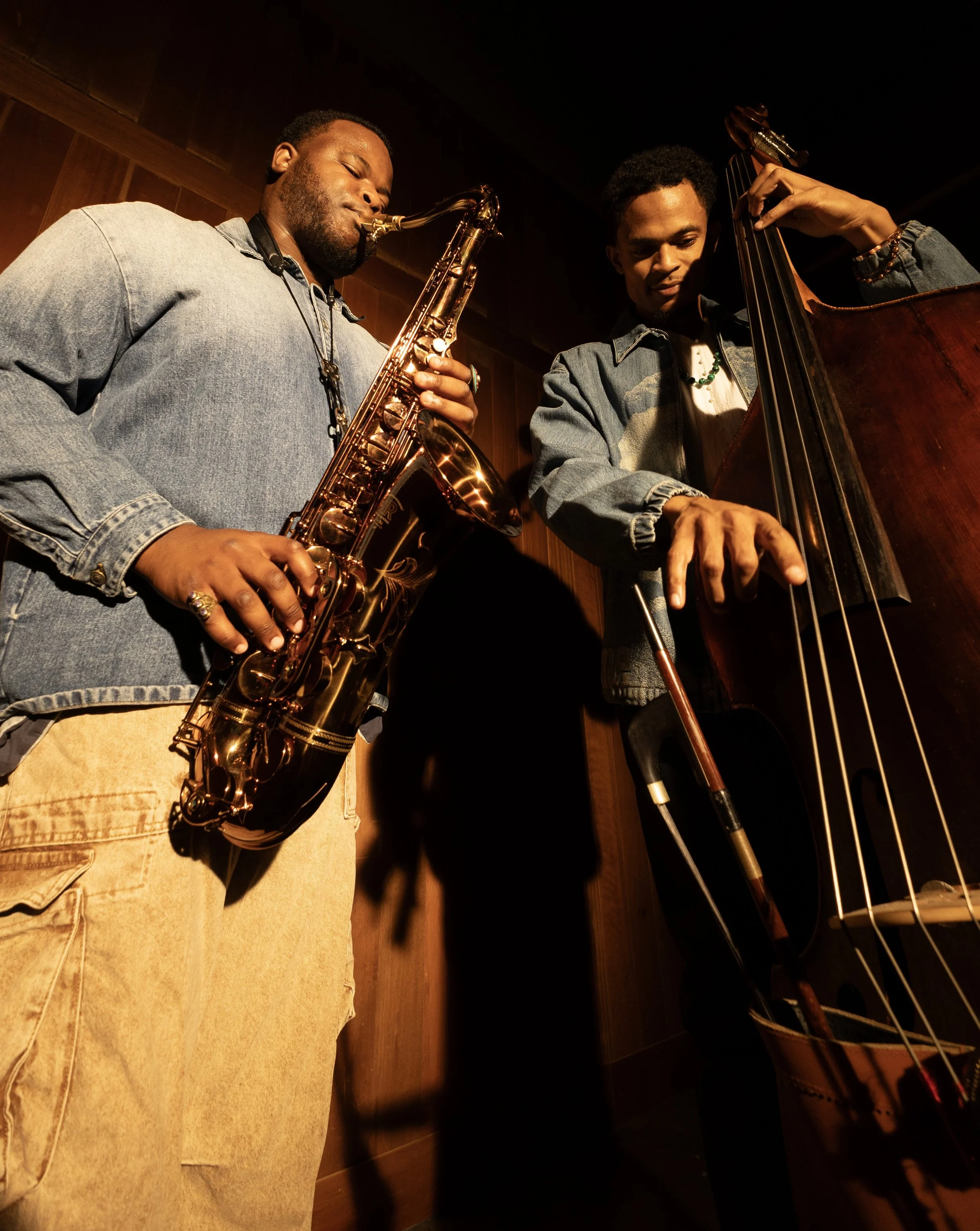
Brothers Aaron and Lawrence Shaw, performing as Black Nile, see a very different Los Angeles. Hollywood has stolen the beautiful story of LA, created a fantasy land from a city with deep Black and Latino roots often without including those communities. For Black Nile, Los Angeles is a city of improvisation, a city of fresh ideas, a city of jazz. Born and raised in LA’s Inglewood neighborhood, the brothers came up in the city’s red hot jazz scene, rubbing shoulders with elder legends as well as next gen stars like Kamasi Washington and Thundercat. Both GRAMMY nominated artists, Aaron Shaw’s saxophone work was recently featured in collaboration with Saul Williams and Carlos Niño, he’s played with contemporary greats from Tyler, The Creator to Herbie Hancock, and gave André 3000 flute lessons. Lawrence Shaw has played bass for John Legend, Booker T. and the M.G.’s, Aminé, Nubya Garcia, and Raphael Saadiq, and is currently touring with pop star Andy Grammar. Both well-seasoned touring musicians,
Black Nile was born from their desire to bring jazz into a new century. Adopting sampling and modern production techniques that they learned from hip-hop, Black Nile’s improvisation is wildly inventive and combustible. Invited as artists in residence at MASS MoCA in 2025, Black Nile’s new album, Indigo Garden, will be released April 10, 2026 on MASS MoCA Records and will feature cover art from renowned conceptual artist Charles Gaines. Bringing in some of the best jazz musicians in LA to flesh out the band, like keyboardists Luca Mendoza and Brian Hargrove, and drummer Myles Martin, Indigo Garden is both an homage to the brothers’ LA roots and a bold step forward for the city’s jazz tradition.
Growing up in Inglewood, Aaron and Lawrence came to jazz through their father’s record collection. A jazz musician himself, he pushed them to listen to a wide range of historical Black American music and raised them to understand the Black genocide that’s gone on in this country. Brought up on Malcolm X and with grandparents who were Garveyites in the 1920s, they learned from their father that jazz was a form of rebellion. As Aaron remembers, they weren’t formally trained in the technical intricacies of jazz until high school. “Everything up until then was the learned and shared experience of jazz.” Listening to jazz and playing in church was key to the brothers’ upbringing, grounding them in music as a way to celebrate community.
The brothers see jazz as larger than the idiom. They see jazz in the way local hero Nipsey Hussle moved, the way he represented his community. They see jazz in the fashion of Tyler the Creator, who grew up in their neighborhood. They understood jazz early on in the freewheeling improvisation of Odd Future’s YouTube videos, skipping school and pulling pranks. “We see how jazz is like this zeitgeist in American music and culture,” Lawrence explains,” where you can't put a finger on it, yet you know it's there. It's in the way people move. People who grew up here like to take elements from it and use that to fuel their own artistry or their own craft. It's beyond music, to be honest; it's in the culture.”
At the same time, their vision of jazz is very Los Angeles. Growing up after the big 1990s movement coming out of Leimert Park–the Harlem of LA in terms of jazz–both brothers listened to OG jazz giants like drummers Tony Williams and Ronald Bruner Sr or bandleader Gerald Wilson. They also came up listening to the next generation, like Kamasi Washington, Terrace Martin, and Thundercat, who would go on to revitalize jazz through their work with Kendrick Lamar and others. Much of this scene came together around high school jazz bands and orchestras. “It’s a lineage that we were able to witness and be a part of,” Lawrence explains. “Jazz is one of those things. There's no linear way to get into it, there's no way to get out of it. Once you get into it, you learn to just go with the flow, and if you really like somebody, you have to ask them how to see them more. So with Kamasi and the other cats, we kept close in order to give us a launching pad and to see how they did things.”
Leimert Park and the new jazz renaissance wasn’t happening in a vacuum. Fueled by Black artists and community organizers, part of the goal was to bring opportunities to a historically underserved neighborhood riven by crime and violence. Venues like the World Stage, where both brothers performed frequently, offered a glimmer of hope and optimism, a kind of oasis. Though they lived in Inglewood, the brothers would often travel to the Crenshaw District to ingest the culture there, to network and jam, building connections. They both studied under a key organizer in the area, Fernando Pullum, whose cultural center and work at Washington High School was a nexus for young jazz musicians. Jazz programs at key high schools have long driven generations of jazz leaders, among them Charles Mingus, Yusef Lateef, and Billy Higgins. “Jazz doesn’t have the resources,” Lawrence says. “So we tend to latch and lean on to people who provide education, who provide sustenance.”
For Black Nile, jazz isn’t a musical genre as much as it is a language. A Black American form of communication that bridges music, visual art, and performance. An improvisational mindset that fits into nearly any genre derived from the Black experience.